
GRE Fractions and Decimals: Quantitative Comparison Tips
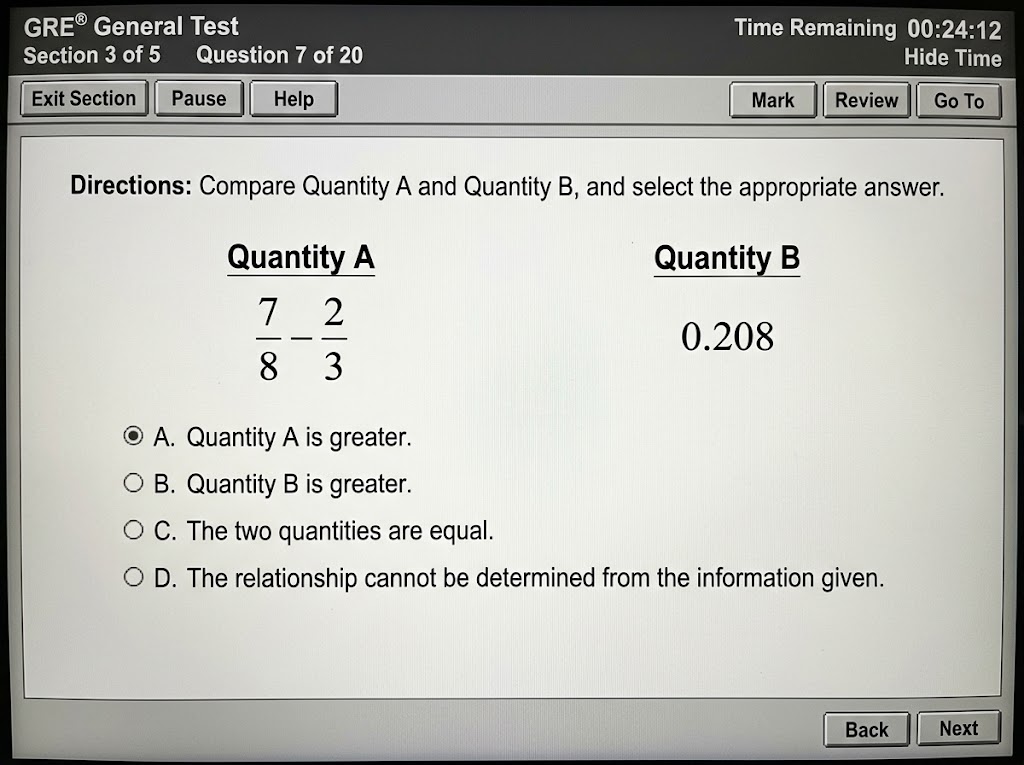
On GRE Quantitative Comparison questions involving fractions and decimals, you almost never need to find exact values — you need to know which side is bigger, which you can usually establish by benchmarking against 1/2 or 1, cross-multiplying, or comparing numerators and denominators directly. The one rule that trips up more students than any other: fractions between 0 and 1 get smaller when you square them and bigger when you take their root.
If you’re just starting your GRE journey, it can help to first see where Quantitative Comparison fits into the bigger picture of the GRE Quantitative Reasoning section. From there, you can decide whether you want to self-study QC using guides like this one, work one-on-one with a GRE prep tutoring instructor, or contact us for more information.
Why Are Fractions So Common on GRE QC Questions?
Because fractions between 0 and 1 break the intuition students built in every other math class. Multiplying usually makes things bigger. Squaring usually makes things bigger. Dividing usually makes things smaller. Inside the interval from 0 to 1, all three of those reverse — and the test writers know that most test-takers will reason from habit rather than from the actual number.
That makes fractions the ideal material for Quantitative Comparison, where the four answer choices are always the same:
- (A) Quantity A is greater
- (B) Quantity B is greater
- (C) The two quantities are equal
- (D) The relationship cannot be determined from the information given
A question that behaves one way for whole numbers and the opposite way for fractions is a (D) waiting to happen — and a question with a constraint like “x > 1” is the same question with the trap defused.

What’s the Fastest Way to Compare Two Fractions?
Benchmark against 1/2 and 1
Before any arithmetic, ask where each fraction sits relative to familiar landmarks. A fraction is greater than 1/2 when the numerator is more than half the denominator, and greater than 1 when the numerator exceeds the denominator.
Quantity A: 7/15 Quantity B: 9/16
Seven is less than half of fifteen, so Quantity A is below 1/2. Nine is more than half of sixteen, so Quantity B is above 1/2. The answer is (B) with no calculation at all. Benchmarking resolves a surprising share of fraction comparisons outright.
Cross-multiply when benchmarking isn’t decisive
When both fractions sit on the same side of your benchmark, cross-multiply: multiply each numerator by the opposite denominator and compare the products.
Quantity A: 5/8 Quantity B: 7/11
Cross-multiplying gives 5 × 11 = 55 against 7 × 8 = 56. Since 56 is larger and it sits on Quantity B’s side, the answer is (B). This works only when both denominators are positive — with a negative denominator the comparison flips. If the mechanics are rusty, the cross multiplication guide walks through the procedure step by step.
Compare the gap to the whole
For fractions just under 1, compare how far each is from 1 rather than comparing the fractions themselves.
Quantity A: 98/99 Quantity B: 99/100
Quantity A is 1/99 below 1; Quantity B is 1/100 below 1. Since 1/100 is the smaller shortfall, Quantity B is closer to 1 and therefore larger — (B). Converting these to decimals would waste thirty seconds and risk a rounding error.
Convert to decimals only when the numbers are friendly
Memorize the common conversions — 1/8 = 0.125, 1/6 ≈ 0.167, 1/3 ≈ 0.333, 3/8 = 0.375, 5/8 = 0.625, 2/3 ≈ 0.667, 7/8 = 0.875 — and convert when a question mixes formats. Otherwise stay in fractions, since converting introduces rounding decisions you don’t need to make.
Which Fraction Traps Make the Answer (D)?
Squaring a fraction makes it smaller
Given: 0 < x < 1
Quantity A: x² Quantity B: x
With x constrained between 0 and 1, squaring always shrinks the value, so Quantity B is always greater — (B). Remove that constraint and let x be any real number, and the answer becomes (D), because x = 2 reverses it.
Square roots of fractions get bigger
Given: 0 < y < 1
Quantity A: √y Quantity B: y
The square root of a number between 0 and 1 is larger than the number itself — √0.25 = 0.5. So Quantity A wins: (A). Students who picture square roots as “making things smaller” reliably miss this.
Dividing by a fraction makes things bigger
Given: n > 0
Quantity A: n ÷ (1/4) Quantity B: n × 4
Dividing by one-fourth is the same as multiplying by four, so the quantities are equal — (C). The same identity in reverse is why multiplying by a fraction shrinks a value.
Decimal place value in disguise
Quantity A: 0.4² Quantity B: 0.4
0.4 squared is 0.16, not 1.6 — a decimal between 0 and 1 follows the same shrinking rule as a fraction, because it is one. The answer is (B). Misplacing a decimal point here is a pure speed error, and it costs a full question.
Each of these patterns shows up repeatedly across a full practice set. The most common GRE QC traps post catalogs the variations you’re most likely to see on test day.

How Do Negative Fractions Change the Rules?
Everything above assumes positive values. Introduce negatives and the behavior inverts again:
- Squaring a negative fraction produces a positive result, so −1/2 squared is 1/4 — larger than the original
- A negative fraction is always smaller than any positive fraction, no matter how the digits compare
- Between two negative fractions, the one closer to zero is the larger value — −1/8 is greater than −1/2
- Multiplying or dividing an inequality by a negative fraction reverses the inequality sign
This is why “x is a real number” and “x is positive” produce completely different answers to otherwise identical questions. Read the constraint line first, every time.
What About Mixed Numbers and Percent Comparisons?
When a question mixes formats — a fraction against a decimal against a percent — convert everything into whichever format has the simplest arithmetic, usually fractions. Remember that a percent is just a fraction with a denominator of 100, so 37% and 37/100 are the same object presented two ways.
For mixed numbers, compare whole-number parts first and only look at the fractional parts if the whole numbers tie. Comparing 3 1/4 against 2 7/8 takes one second, because 3 beats 2 and nothing about the fractional parts can close a full unit of gap.
How Should You Practice Fraction and Decimal QC?
- Drill benchmarking first — take twenty random fractions and sort each as above or below 1/2 in under three seconds apiece.
- Memorize the eighths, sixths, and thirds as decimals. These recur constantly and recognition saves more time than any technique.
- Work a set where every question involves a value between 0 and 1, so the squaring and rooting behavior becomes reflexive rather than something you reason out.
- Then work a mixed set and force yourself to name the technique — benchmark, cross-multiply, or compare the gap — before touching the numbers.
The GRE QC practice questions by type set lets you isolate fraction questions, and if arithmetic confidence is the real issue rather than strategy, how to build test-taking confidence is a useful companion read.
Ready to Stop Losing Points to Fractions?
Fraction errors on QC are rarely knowledge gaps — they’re habits, and habits are hard to spot in your own work. A tutor reviewing a timed set can usually identify the specific reversal you keep missing within one session. Jantzi Test Prep provides online GRE tutoring remotely, so sessions fit around your schedule rather than your location. Contact us to talk through your quant score and what it would take to raise it.
Frequently Asked Questions About GRE Fractions and Decimals
Should I convert fractions to decimals on the GRE?
Only when the conversion is one you already know by heart, like eighths or quarters. Otherwise stay in fractions — benchmarking and cross-multiplication are faster than division and don’t introduce rounding error.
Why is a fraction smaller when you square it?
Because squaring multiplies the number by itself, and multiplying by anything less than 1 reduces a value. One-half of one-half is one-quarter. The same logic explains why square roots of such numbers come out larger.
Can I use the on-screen calculator for fraction comparisons?
You can, but it usually slows you down. The GRE calculator works in decimals, so you’d convert both fractions and then compare — two operations where benchmarking often needs zero. Save it for genuinely messy arithmetic.
How do I compare a fraction to a decimal quickly?
Benchmark both against 1/2 and 1 first; that resolves many pairs immediately. If they land on the same side, convert the fraction to a decimal if it’s a familiar one, or turn the decimal into a fraction over 10, 100, or 1,000 and cross-multiply.
Are fraction questions more likely to have (D) as the answer?
They’re more likely to produce (D) when the prompt allows values across different categories — negatives, fractions, and whole numbers all at once. A constraint like “0 < x < 1” or “x is an integer greater than 1” usually removes that possibility.
Does remote GRE tutoring work for arithmetic fundamentals?
Yes. Fundamentals coaching is mostly about watching someone work and catching the specific step where they go wrong, which a shared screen handles well — and it means you’re matched with the right instructor rather than the closest one.
